What Is Xanthan Gum?
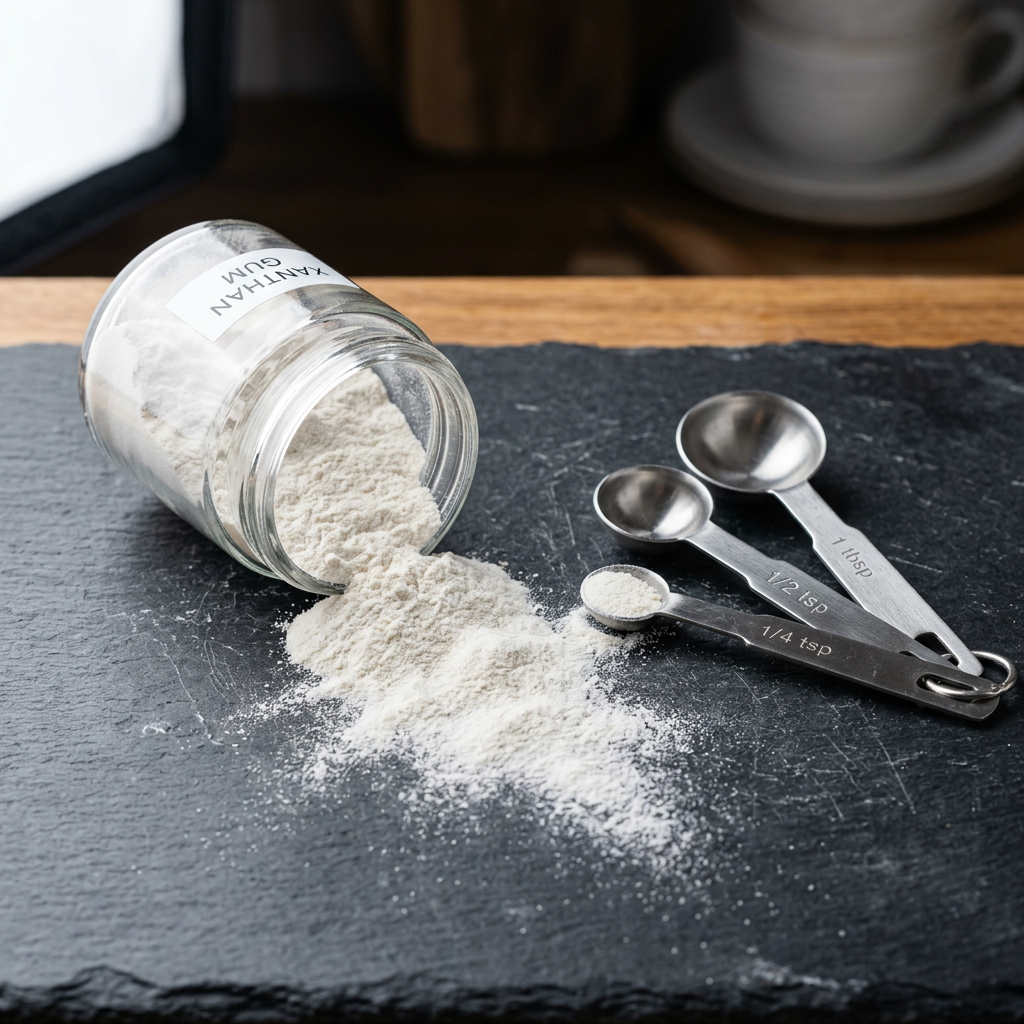
Xanthan gum (E415) is a polysaccharide produced through the fermentation of glucose or sucrose by the bacterium Xanthomonas campestris. Discovered in the 1960s by the US Department of Agriculture, it has since become a cornerstone of the global food additive industry — and increasingly important in pharmaceuticals, cosmetics, and industrial applications.
At its core, xanthan gum is a thickener, stabiliser, and emulsifier. Even at very low concentrations (0.1–0.5%), it dramatically increases the viscosity of liquids, making it one of the most effective and cost-efficient functional ingredients available.
Key Uses of Xanthan Gum
Food & Beverage
Xanthan gum is ubiquitous in the modern food supply. Its primary applications include:
- Gluten-free baking — acts as a structural binder replacing gluten in breads, cakes, and pastries
- Salad dressings & sauces — prevents oil-water separation and maintains smooth, pourable texture
- Dairy products — stabilises ice cream, yoghurt, and cream cheese against syneresis
- Beverages — suspends fruit pulp and particles in juices, smoothies, and flavoured drinks
- Processed meats — improves texture, moisture retention, and sliceability
- Low-fat products — mimics the mouthfeel of fat when fat content is reduced
Pharmaceutical & Personal Care
- Tablet binders and controlled-release drug delivery
- Toothpaste and gel formulations (provides texture and prevents ingredient separation)
- Wound care gels and medical-grade lubricants
Industrial
- Oil & gas drilling fluids — one of the largest non-food uses; xanthan gum stabilises drilling muds
- Paints and coatings — prevents settling of pigments
- Agricultural chemicals — improves suspension stability of pesticide formulations
Quality Standards: What to Look For
Not all xanthan gum is equal. When procuring food-grade xanthan gum, buyers should evaluate the following parameters:
| Parameter | Food Grade Standard | |---|---| | Purity | ≥ 91% xanthan gum on dry basis | | Viscosity (1% solution, 25°C) | 1,200 – 1,700 mPa·s (Brookfield) | | Moisture content | ≤ 15% | | Pyruvate content | ≥ 1.5% | | Ash content | ≤ 16% | | Heavy metals | ≤ 20 mg/kg total | | Microbiological | Salmonella absent / 25g; E. coli < 30 CFU/g | | Particle size | 200 mesh (fine powder preferred for most food applications) |
Key certifications to request: EU E415 compliance, Kosher, Halal, Non-GMO (if substrate is non-GM glucose/sucrose), ISO 22000 or FSSC 22000 facility certification.
Non-food grade vs food grade: Industrial-grade xanthan gum is significantly cheaper but must never enter the food supply chain. Always request a Certificate of Analysis (CoA) and verify lot traceability.
Industrial-Scale Producers
The global xanthan gum market is dominated by Chinese producers, who collectively account for over 70% of world supply. Key industrial-scale manufacturers include:
China (dominant global suppliers):
- Deosen Biochemical (Ordos) Ltd — one of the world's largest single-site producers; supplies major food multinationals globally
- Fufeng Group — publicly listed, vertically integrated producer; significant EU and US export volumes
- Meihua Holdings Group — diversified fermentation company; growing xanthan gum capacity
- Jianlong Biotechnology — specialises in fermentation-derived food additives
Europe & Americas:
- CP Kelco (USA/Denmark) — a legacy producer with premium-grade products for pharmaceutical and high-specification food applications; commands significant price premiums
- Jungbunzlauer (Austria) — well-regarded for consistent EU-compliant grades
- ADM (USA) — produces under the Kelzan brand for industrial and food applications
For most European food manufacturers, Chinese-origin material (properly certified) offers the best value. For pharmaceutical or high-specification applications, CP Kelco and Jungbunzlauer remain the preferred sources despite the price premium.
Price & Demand: 2024–2026
Pricing Trajectory
| Period | Indicative CFR Europe Price (Food Grade) | |---|---| | Q1 2024 | €3.20 – €3.60 / kg | | Q3 2024 | €3.00 – €3.40 / kg | | Q1 2025 | €3.10 – €3.50 / kg | | Q3 2025 | €3.40 – €3.90 / kg | | Q1 2026 | €3.60 – €4.20 / kg |
After a soft patch in mid-2024, prices have trended upward through 2025 and into 2026, driven by:
- Rising energy costs at Chinese fermentation facilities (coal and natural gas price increases)
- Corn/glucose feedstock price increases — corn is the primary fermentation substrate, and global corn markets tightened through 2025
- Stronger-than-expected demand from the gluten-free food sector and the oil & gas industry
- EU import scrutiny — additional testing requirements for Chinese additives have added compliance cost and extended lead times
Demand Outlook
Global xanthan gum demand is forecast to grow at approximately 5.5–6.5% CAGR through 2028, driven by:
- Gluten-free food category expansion — now a mainstream consumer segment, not just a medical diet
- Oil & gas drilling activity — particularly deepwater and unconventional drilling which requires high-performance xanthan muds
- Personal care growth — rising demand for natural-label functional ingredients in skin care and hair care
- Clean-label reformulation — food manufacturers replacing synthetic thickeners with xanthan gum
Supply Risk Factors to Watch
- Chinese export policy changes — any shift in export duties or quotas would immediately tighten European supply
- EU food additive re-evaluation — EFSA is conducting routine re-evaluations of approved additives; no current concern for E415 but worth monitoring
- Currency movements — EUR/CNY fluctuation directly impacts landed cost for European buyers
Foodiglobal's Position
Foodiglobal supplies food-grade xanthan gum (E415) from verified, EU-compliant Chinese manufacturers. We offer:
- Full documentation packages (CoA, Halal, Kosher, Non-GMO on request)
- Flexible order sizes — from 100kg samples to full container loads
- Competitive CFR European port pricing with transparent cost breakdowns
- Fast quote turnaround — within 24 hours
Contact our team to discuss your current requirements or request a sample.
Pricing data is indicative, based on Foodiglobal market intelligence as of April 2026. Actual prices are subject to confirmation at time of order.